

Biomass energy ranks as the fourth most consumed energy source in the world, following coal, oil, and natural gas. While the first three are fossil fuels and non-renewable, biomass energy is renewable, offering a positive contribution to the sustainable development of human society.
Biomass gasification technology is an emerging biomass energy utilization method. It converts biomass into syngas through thermochemical reactions under high temperatures using gasification agents such as oxygen (air, oxygen-enriched gas, or pure oxygen), steam, or hydrogen. This process also generates by-products like biochar and tar. The technology can convert low-grade solid biomass into high-grade combustible gas, which can be widely applied in industries such as methanol synthesis, centralized gas supply, heating, and power generation. Although more complex than direct combustion, gasification improves biomass utilization efficiency and yields high-value by-products, offering superior economic benefits.
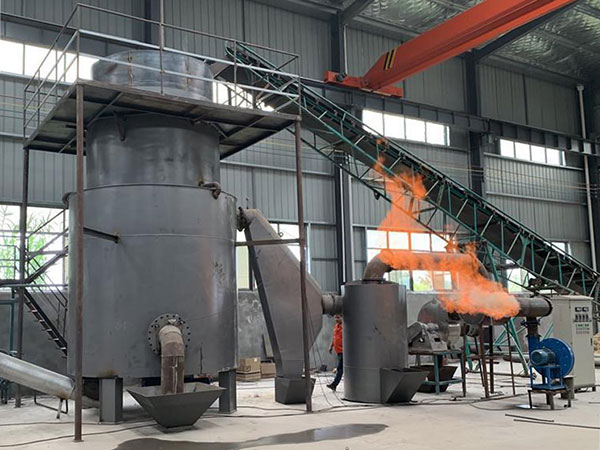
Biomass gasifiers are thermal devices used for biomass gasification and are classified into fixed-bed and fluidized-bed types. Fixed-bed gasifiers can be further divided into updraft gasifiers, downdraft gasifiers, and crossdraft gasifiers. Each gasifier operates with slight variations, featuring unique advantages and drawbacks, making them suitable for different applications. GEMCO Energy primarily produces updraft and downdraft fixed-bed gasifiers. Today, we’ll explore the differences between these two gasifiers, along with their design characteristics and principles, to help customers choose according to their production needs.
Design Characteristics of the Updraft Gasifier
Working Principle
In an updraft fixed-bed gasifier, biomass feedstock is introduced from the top of the gasifier. The entire fuel bed is supported by the grate at the bottom of the combustion chamber. The gasification agent enters the furnace from the air inlet at the bottom, evenly distributed through the grate and infiltrating the ash layer at the bottom of the fuel bed. The gasification agent exchanges heat with the ash, preheating the agent and cooling the ash. The agent then rises into the combustion zone, where it reacts with the carbon in the biomass, releasing significant heat and raising the furnace temperature to around 1000°C. This heat maintains the gasification process. The flow continues upward to the reduction zone, where CO2 from the combustion zone is reduced to CO, and water vapor in the gasification agent breaks down into H2 and CO2. These gases, along with unreacted portions of the agent, rise and heat the upper fuel layer, causing it to undergo pyrolysis and produce charcoal, which falls into the reduction zone. The generated gases continue upward, preheating and drying the incoming biomass before exiting the gasifier through the gas outlet.

Advantages
High thermal efficiency: The pyrolysis and drying zones utilize the residual heat from the gases in the reduction zone, resulting in low exit gas temperatures. Additionally, the bottom combustion zone receives sufficient air, ensuring thorough combustion of the charcoal, leading to a high gasification rate.
High adaptability: Updraft gasifiers tolerate fuel moisture content of up to 30%, making them ideal for processing biomass with high moisture content, such as agricultural residues or wood chips.
Low investment costs: The design is relatively simple, with fewer required components, leading to lower production and maintenance costs, making it suitable for small- and medium-sized projects.
Limitations
High tar content: Since the gas flows upward while the heat flows downward, tar cannot be completely cracked in the pyrolysis zone, resulting in higher tar content. Additional purification equipment is required to handle tar, increasing system complexity and costs.
High demands for gasification agent control: Precise control of gasification agent flow and distribution is necessary to ensure process stability and consistent gas production. Mismanagement may result in reduced efficiency or equipment blockage.
Design Characteristics of the Downdraft Gasifier
Working Principle
In a downdraft gasifier, biomass feedstock is fed from the top, with air entering from the upper sides of the furnace walls. The produced syngas is extracted from the bottom of the furnace. This arrangement, where the material and gas flow in the same direction, is also known as a co-current gasifier. In the oxidation zone, located in the middle of the furnace, air mixes with the feedstock and burns at temperatures of 900–1200°C. The heat generated drives the pyrolysis and reduction reactions above and below the oxidation zone, respectively. The upper pyrolysis zone, with temperatures ranging from 300–700°C, separates volatile components (gas, tar, and water) from the biomass. The top layer is the drying zone, where feedstock is preheated. Below the oxidation zone is the reduction zone, where CO2, carbon, and steam from the oxidation zone undergo reduction reactions. Remaining tars are cracked in this zone, producing syngas rich in CO and H2.
Advantages
High-quality syngas: The gas produced in downdraft gasifiers passes through hot oxidation and reduction zones, effectively cracking tar, resulting in clean syngas with minimal tar content. This makes downdraft gasifiers ideal for applications requiring clean gas.
Stable combustion control: The gasification process in downdraft gasifiers is more stable. Additionally, since the feedstock comes into contact with air at the feeding end, the top of the furnace doesn’t need strict sealing in negative pressure conditions, allowing continuous feeding during operation and enabling fire-stoking.
Suitable for small-scale applications: Downdraft gasifiers require biomass feedstock with consistent particle size and low moisture content, making them suitable for handling fine, dry materials such as wood chips or biomass pellets. They perform well in small-scale power or heating projects, especially in cases requiring high-quality syngas, like small communities or industrial applications.
Limitations
Low tolerance for fuel moisture: Downdraft gasifiers typically require fuel moisture content to be below 20%. Higher moisture content may reduce gasification efficiency or even cause blockage or failure, often necessitating additional drying equipment during feedstock preparation, increasing production costs.
Strict fuel particle size requirements: Downdraft gasifiers can only handle fuels with uniform particle size, requiring pre-treatment of biomass to ensure appropriate sizing. Unlike updraft gasifiers, which can process larger, wetter materials, downdraft gasifiers demand higher fuel consistency.
GEMCO Energy
If you have any questions about biomass gasification projects or want to learn more about the details of updraft and downdraft gasifiers, our expert team is always available for consultation and technical support. Contact us now to receive customized solutions and equipment quotes tailored to your project!